


THE AGREEMENT BETWEEN LITHUANIA'S AND CHINA'S SUPERVISORY INSTITUTIONS MADE WAY FOR LITHUANIA'S DIRECT INVESTMENTS IN CHINESE YUAN
With the Bank of Lithuania and China’s securities regulatory commission having agreed in regards to cooperation in the field of securities regulation, Lithuania’s financial institutions could directly invest in China’s capital market. “The agreement between Lithuania’s and China’s supervisory institutions opened the door for Lithuania’s financial institutions to seek qualified foreign institutional investor status, which is necessary for direct investment in China’s financial market, which is opening up more and more,” said Ingrida Šimonytė, Deputy Chairperson of the Board of the Bank of Lithuania. I. Šimonytė met in Vilnius with Lin Xinhua, Vice-Chairman of the China’s securities regulatory commission, and discussed prospects of cooperation between the two institutions. The guest was introduced to the financial market consolidated regulation model. The heads of Lithuania’s and China’s supervisory institutions signed a Memorandum of Understanding regarding securities and future regulatory cooperation. As indicated in the Memorandum, its purpose is to promote investor protection and integrity of the securities, futures and other related investment products markets by providing a framework for cooperation, including channels of communication, increasing mutual understanding and exchange of regulatory and technical information. China’s economy, which is second in size in the world, recently has become more and more interesting for Lithuania’s investors; therefore, by signing the Memorandum of Understanding regarding cooperation, the Bank of Lithuania enabled all of Lithuania’s financial institutions to directly invest in China’s securities market. Lithuania’s financial institutions can now turn to China’s securities regulatory commission in regards to receiving qualified foreign institutional investor status, which gives them the right to invest in Chinese Yuan Renminbi in China’s domestic capital market. Source: Bank of Lithuania
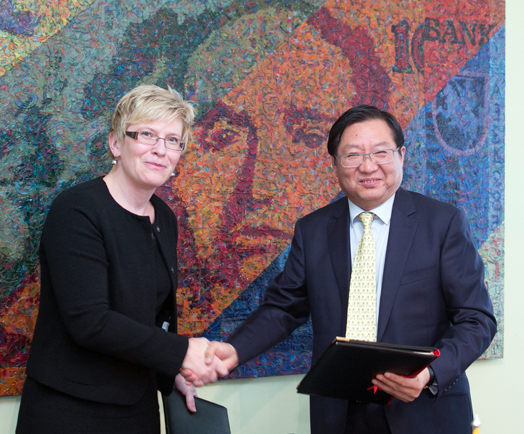 With the Bank of Lithuania and China’s securities regulatory commission having agreed in regards to cooperation in the field of securities regulation, Lithuania’s financial institutions could directly invest in China’s capital market.
“The agreement between Lithuania’s and China’s supervisory institutions opened the door for Lithuania’s financial institutions to seek qualified foreign institutional investor status, which is necessary for direct investment in China’s financial market, which is opening up more and more,” said Ingrida Šimonytė, Deputy Chairperson of the Board of the Bank of Lithuania.
I. Šimonytė met in Vilnius with Lin Xinhua, Vice-Chairman of the China’s securities regulatory commission, and discussed prospects of cooperation between the two institutions. The guest was introduced to the financial market consolidated regulation model.
The heads of Lithuania’s and China’s supervisory institutions signed a Memorandum of Understanding regarding securities and future regulatory cooperation. As indicated in the Memorandum, its purpose is to promote investor protection and integrity of the securities, futures and other related investment products markets by providing a framework for cooperation, including channels of communication, increasing mutual understanding and exchange of regulatory and technical information.
China’s economy, which is second in size in the world, recently has become more and more interesting for Lithuania’s investors; therefore, by signing the Memorandum of Understanding regarding cooperation, the Bank of Lithuania enabled all of Lithuania’s financial institutions to directly invest in China’s securities market. Lithuania’s financial institutions can now turn to China’s securities regulatory commission in regards to receiving qualified foreign institutional investor status, which gives them the right to invest in Chinese Yuan Renminbi in China’s domestic capital market.
Source: Bank of Lithuania


